Valley of Dry Bones Meaning: Best Guide for Christians
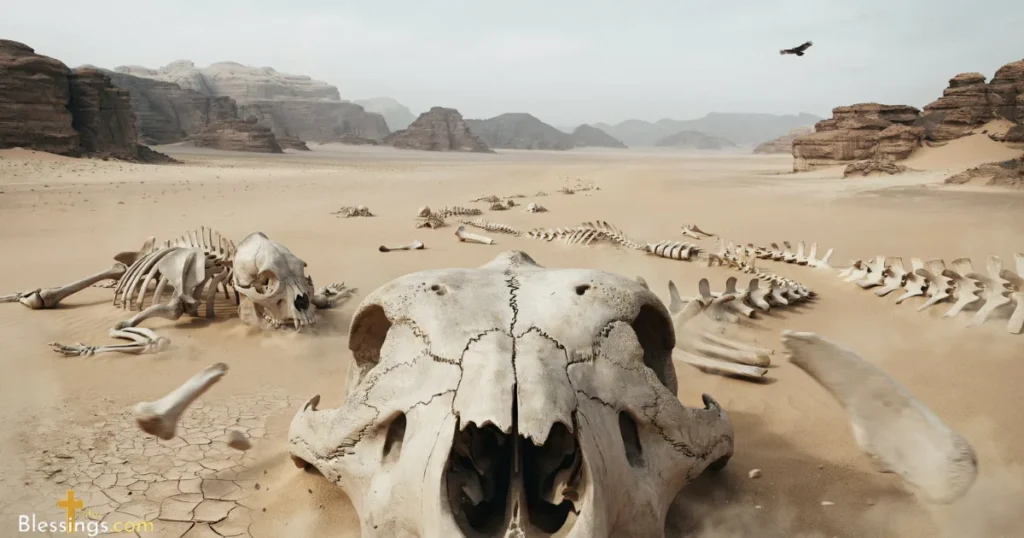
Few passages in Scripture carry the sheer dramatic weight of Ezekiel 37’s Valley of Dry Bones. A prophet stands in an open field littered with scattered, sun-bleached bones completely lifeless, beyond all human hope. God then does something extraordinary: He breathes life back into what was utterly dead.
This vision wasn’t just a spectacle. It was a divine message about national restoration, spiritual resurrection, and the unstoppable power of God over death and despair. Whether you read it as a prophecy for ancient Israel, a picture of Holy Spirit renewal, or a personal promise for your own dead seasons, the breath of life changes everything.
Who Was Ezekiel? Historical and Prophetic Background
Ezekiel was a Hebrew priest and prophet carried into Babylonian captivity around 597 BC, roughly a decade before Jerusalem fell. He ministered to Jewish exiles living near the Chebar River in Babylon, a community crushed by loss, stripped of temple worship, and haunted by the question: Has God abandoned us entirely?
His prophetic ministry spanned from approximately 593 to 571 BC, placing him as a contemporary of both Jeremiah (in Jerusalem) and Daniel (in the Babylonian royal court). His book is famous for its apocalyptic imagery, symbolic acts, and visions unlike anything else in the Hebrew canon.
By the time Ezekiel received the vision of Ezekiel 37, the Jerusalem temple had been destroyed (586 BC), Israel’s monarchy had collapsed, and the covenant people faced what felt like national death. It is against this backdrop of total desolation that God brought his prophet to the valley.
The Valley of Dry Bones: What Did Ezekiel Actually See?
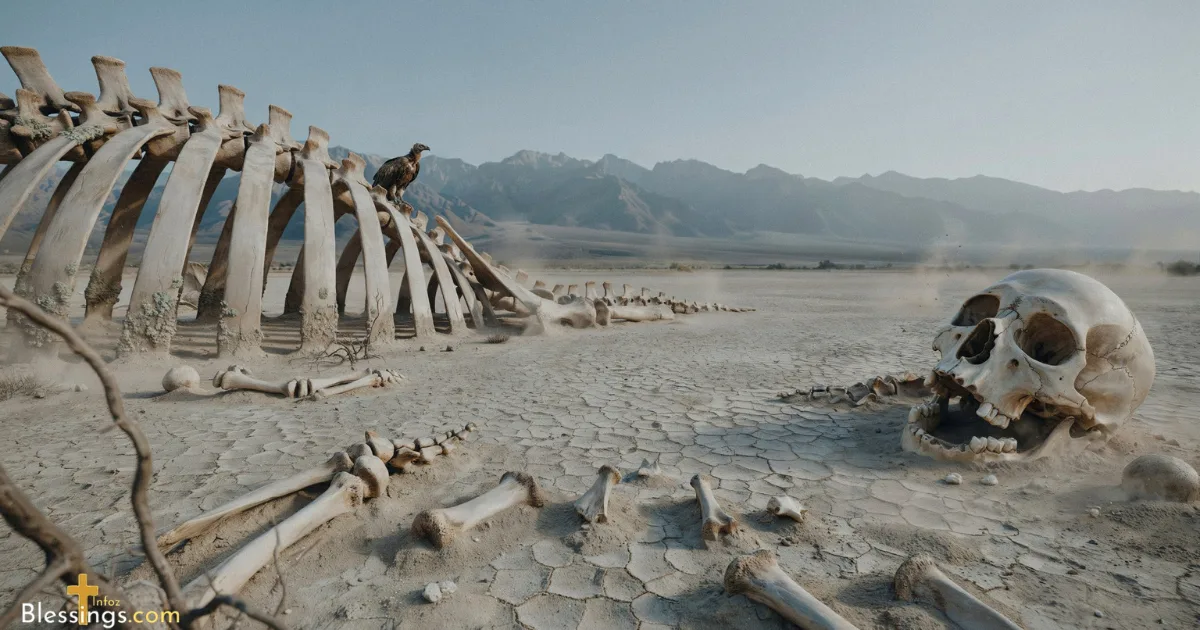
In Ezekiel 37:1–2, the Spirit of the Lord carried Ezekiel into a valley filled with bones. The text emphasizes two striking details:
- The bones were very many not a small burial site, but a vast field
- They were very dry indicating the people had been dead a long time, with no residual life whatsoever
This is not poetic exaggeration. The dryness is theologically intentional. It rules out any natural hope of recovery. These were not people who had almost survived; they were completely, irreversibly dead by human standards.
The valley itself likely echoes the imagery of ancient battlefields, where unburied corpses, a mark of utter disgrace in Hebrew culture, would bleach under the open sky. To an Israelite audience, this was a picture of maximum shame and abandonment.
God’s Question: “Can These Bones Live?” The Deeper Meaning
When God asks Ezekiel, “Son of man, can these bones live?” (Ezekiel 37:3), the question is not a request for information. God already knows the answer. The question is an invitation for Ezekiel to acknowledge his own human helplessness while simultaneously trusting in divine sovereignty.
Ezekiel’s response is profound in its humility: “O Lord God, you know.” He doesn’t answer with optimism or despair. He defers entirely to God. This posture of surrendered trust in the face of impossible circumstances becomes the model for all who must wait on God in dead seasons.
The deeper meaning of the question is this: it forces both Ezekiel and the reader to confront the limits of human agency. Before God can work miraculously, the human witness must acknowledge that only He can do what is needed.
Prophesying to the Bones: The Power of Spoken Word and Obedience
God’s instruction to Ezekiel is startling: “Prophesy to these bones” (Ezekiel 37:4). Speak to the dead. Declare life where there is none.
This is a test of radical obedience. Ezekiel had no guarantee the bones would respond. From a rational standpoint, talking to a pile of bones was foolish. But obedience here did not require understanding; it required faithfulness.
What Happened When Ezekiel Spoke
The sequence in verses 7–8 is deliberate and instructive:
- Ezekiel prophesied as commanded
- A rattling sound bones came together, bone to bone
- Sinews and flesh appeared, and skin covered them
- But there was no breath in them the bodies were formed but still lifeless
This two-stage process is significant. God restored form before breath. It mirrors the creation narrative in Genesis 2:7, where God first formed man from dust, then breathed into him the breath of life. Physical structure alone does not produce life. Something else is required.
The Breath of Life: Understanding the Role of the Holy Spirit
In Ezekiel 37:9–10, God commands Ezekiel to prophesy a second time this time not to the bones, but to the four winds. He is told to call on the breath (Hebrew: ruach) to enter the slain.
The Hebrew word ruach is one of Scripture’s richest terms. It simultaneously means:
- Wind the invisible, powerful force of the natural world
- Breath the animating principle of life
- Spirit the divine presence and power of God
This triple meaning is not accidental. When the ruach entered the bodies in the valley, an exceedingly great army stood on its feet. Life came not through human effort, biological process, or political strategy it came through divine breath.
For Christian interpreters, this passage is one of the Old Testament’s clearest anticipations of the role of the Holy Spirit in regeneration and resurrection. The ruach that animated Israel foreshadows the Spirit given at Pentecost (Acts 2) and the final resurrection described in 1 Corinthians 15.
Israel’s National Restoration: Prophecy and Its Fulfillment
God himself interprets the vision in Ezekiel 37:11–14. The dry bones are explicitly identified: “These bones are the whole house of Israel.” The people had said, “Our bones are dried up and our hope is gone; we are cut off.” God’s response is a three-part promise:
| God’s Promise | Reference | Historical Fulfillment |
| Open your graves | Ezekiel 37:12 | Return from Babylonian exile (538 BC) |
| Bring you back to the land | Ezekiel 37:12 | Re-establishment in Israel |
| Put my Spirit in you | Ezekiel 37:14 | New Covenant and Pentecost |
The return from Babylonian exile beginning in 538 BC under Cyrus the Great is widely seen as a partial fulfillment of this prophecy. For many theologians, the modern re-establishment of the State of Israel in 1948 is viewed as a further stage of fulfillment though this remains a point of theological discussion across traditions.
Theological Significance: Resurrection, Hope, and New Creation
Ezekiel 37 occupies a pivotal place in biblical theology for several reasons:
- It is the clearest Old Testament portrayal of God’s power to restore what appears permanently dead
- It bridges the themes of national restoration (Israel’s return) and individual resurrection (new life through the Spirit)
- It anticipates the new creation language of Isaiah 65–66 and Revelation 21–22
- It grounds Christian hope in God’s track record the same God who raised dry bones can raise the dead
The vision functions as what theologians call a typological prophecy, an event with both an immediate historical referent (Israel’s exile and return) and a deeper eschatological meaning (bodily resurrection and the age to come).
Paul alludes to this framework in Romans 4:17, describing God as one who “gives life to the dead and calls things that are not as though they were.” The valley of dry bones is the backstory to Paul’s entire theology of resurrection hope.
Ezekiel 37 in Different Christian Traditions and Interpretations
The interpretation of this passage varies significantly across theological traditions:
| Tradition | Primary Interpretation |
| Jewish | Metaphor for national exile and return; some read as literal future resurrection |
| Catholic | National restoration + spiritual renewal through the Church |
| Reformed/Presbyterian | Emphasis on divine sovereignty in salvation; Spirit-given regeneration |
| Pentecostal/Charismatic | Focus on Holy Spirit’s power; often applied to spiritual awakening and revival |
| Dispensationalist | Literal future restoration of national Israel in the end times |
| Amillennialist | Fulfilled in the church as the new covenant community of Spirit-filled believers |
What unites nearly all traditions is agreement on the central claim: life comes from God alone, and no situation is beyond His power to restore.
Practical Life Application: Living with Hope in Dead Situations
Ezekiel 37 was written for people in exile who had lost everything they counted on. That makes it remarkably relevant to modern readers.
Three Lessons for Dead-End Seasons
1. Name the death honestly. God didn’t ask Ezekiel to pretend the bones were anything other than dry and dead. Genuine hope doesn’t minimize loss; it acknowledges it and trusts God anyway.
2. Obey before you understand. Ezekiel prophesied without knowing what would happen. Sometimes action in faith precedes evidence of change. The rattling begins after you speak, not before.
3. The Spirit does what you cannot. The bones could be arranged by the Word but only animated by the ruach. In your dead marriages, dead dreams, broken communities, and exhausted faith the same Spirit who moved in the valley still moves today.
Whether you’re facing grief, failed relationships, ministry burnout, national crises, or personal despair, Ezekiel 37 makes a bold declaration: God specializes in impossible situations.
Frequently Asked Questions About Ezekiel 37
What is the main message of Ezekiel 37?
The central message is that God alone can restore what is completely dead whether a nation in exile or a human soul aspiritual ruin through His Word and Spirit.
Who do the dry bones represent in Ezekiel 37?
God explicitly identifies them as the whole house of Israel (Ezekiel 37:11), representing the nation in the hopelessness of Babylonian exile.
Is Ezekiel 37 about the resurrection of the dead?
It has both a national and a resurrection dimension. While the immediate context is Israel’s national restoration, the language of graves opening (v.12–13) and breath entering bodies anticipates bodily resurrection, and Jewish and Christian theologians have long drawn that connection.
What does the “breath” represent in Ezekiel 37?
The Hebrew word ruach means wind, breath, and Spirit simultaneously. It represents the life-giving presence of God, specifically the Holy Spirit, without whom no true life is possible.
Can Ezekiel 37 be applied personally today?
Absolutely. While its primary meaning is national, the spiritual principle is universal: God can breathe life into whatever appears dead in your life, relationships, faith, purpose, or hope when you respond to His Word in obedient
Conclusion
Ezekiel 37 is more than a dramatic vision; it is a theological declaration at the heart of the entire biblical story. God is not defeated by death, not limited by exile, not surprised by desolation. He walks through valleys of dry bones and asks us the same question He asked Ezekiel: “Can these bones live?”
The answer, as the prophet discovered, depends entirely on whose breath you’re waiting for.
For Israel, the promise of national restoration was real and historically fulfilled and by many accounts, still unfolding. For the church, the vision points to the Holy Spirit’s ongoing work of renewal. For every individual standing in a valley of their own, it is an invitation to stop measuring the dryness of the bones and start trusting the God who breathes.