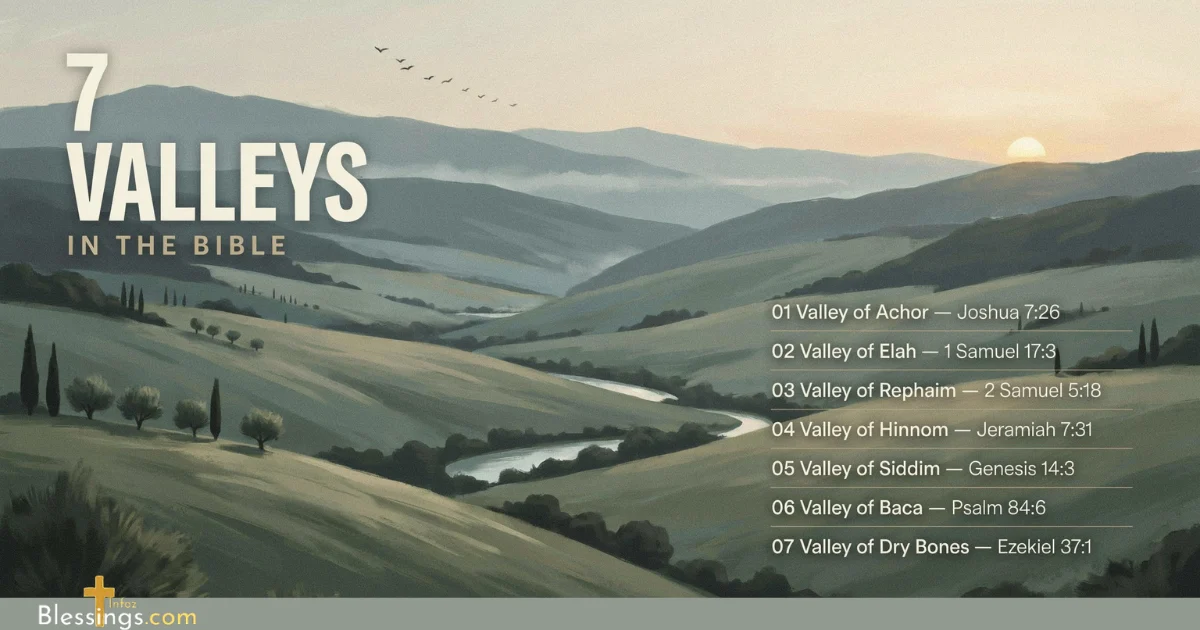
7 Valleys in the Bible Most Christians Overlook
The Bible is filled with powerful landscapes that carry deep spiritual significance and valleys are among the most profound. From dark trials to divine victories, the valleys mentioned in Scripture reveal God’s presence in life’s lowest moments.
These sacred places are not just geographical locations; they are symbols of faith, struggle, and transformation. In this guide, we will explore 7 valleys in the Bible, uncovering their names, meanings, and the timeless lessons they hold for believers today. Whether you are studying biblical geography or seeking spiritual growth, understanding these valleys will deepen your Scripture study and strengthen your walk with God.
What Does “Valley” Mean in Biblical Hebrew?
Before diving into the valleys themselves, it helps to know that the Bible uses at least three distinct Hebrew words translated as “valley” in English and the difference matters.
- Gai (גַּיְא) a narrow gorge or ravine, often with dark or ominous associations (e.g., Valley of Hinnom)
- Emek (עֵמֶק) a wide, broad valley suitable for agriculture or military campaigns (e.g., Valley of Jezreel)
- Nahal (נַחַל) a wadi or seasonal stream bed (e.g., Kidron Valley)
Most English translations, whether KJV, NIV, or ESV, don’t distinguish between these words, which is why two valleys can feel completely different in character even though they share the same English label.
The 7 Most Significant Valleys in the Bible
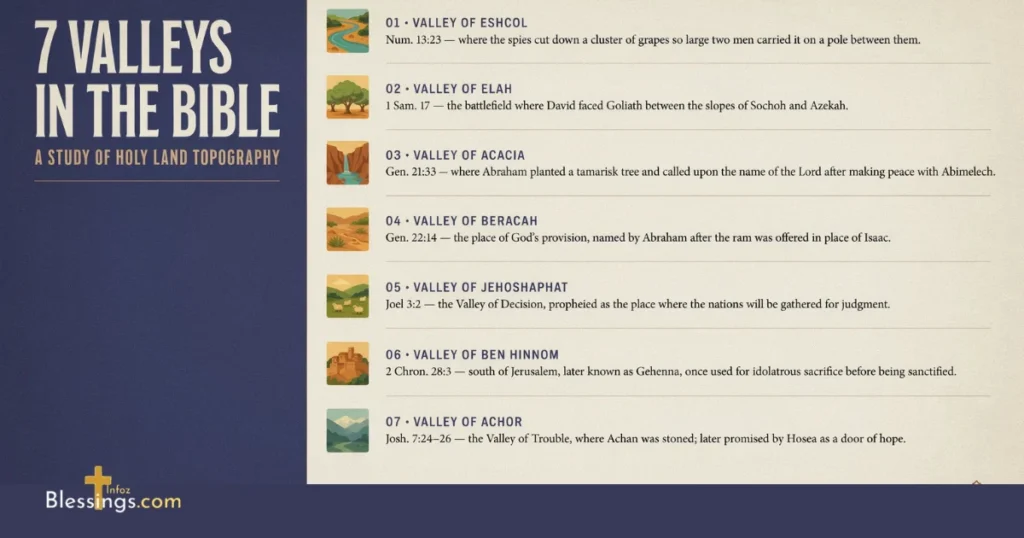
1. The Valley of Elah-Where Faith Defeated Fear
Key Scripture: 1 Samuel 17:2–3 Hebrew Term: Emek (broad valley) Location: Southwest of Jerusalem, in the Shephelah lowlands
The Valley of Elah is where one of the Bible’s most retold confrontations took place, a young David facing the Philistine giant Goliath. The two armies were camped on opposing hillsides, with the valley serving as the open ground neither side wanted to cross. Until David did.
What makes this valley theologically rich is not just the battle itself, but what it illustrates: that geography in Scripture is often a mirror for spiritual reality. The valley between the armies was a place of fear, hesitation, and stalemate exactly where faith is asked to step forward.
Archaeologically, the Valley of Elah (Wadi es-Sant) is well-documented and sits near the modern Israeli city of Beit Shemesh. Visitors can still find smooth stones in its riverbed.
2. The Valley of Jezreel-Battlefield of the Ages
Key Scripture: Judges 6–7; Hosea 1:5; Joel 3:2; Revelation 16:16 Hebrew Term: Emek Yizre’el Location: Northern Israel, between Mount Carmel and the Jordan Valley
The Valley of Jezreel, also called the Plain of Megiddo, is the single most fought-over piece of land in the ancient Near East. Pharaohs, Assyrians, Crusaders, Ottomans, and British forces have all clashed here. Gideon routed the Midianites in this valley with just 300 men (Judges 7). Saul fell here in battle (1 Samuel 31). And the prophet Hosea spoke of it as a place of divine judgment.
The valley’s connection to Armageddon is where many readers today encounter it first. The word “Armageddon” derives from the Hebrew Har Megiddo Hill of Megiddo overlooking this very valley. Revelation 16:16 identifies it as the gathering place for the final battle of the ages.
What’s often misunderstood: Armageddon is not exclusively a New Testament concept. The prophetic weight of this valley runs from the book of Judges through Joel, Zechariah, and into Revelation, a through-line spanning centuries of Scripture.
Tel Megiddo, which overlooks the valley, is today a UNESCO World Heritage Site.
3. The Valley of Hinnom – From Sacrifice to Symbol
Key Scripture: Joshua 15:8; 2 Kings 23:10; Matthew 5:22, 29–30 Hebrew Term: Gai Ben-Hinnom (gorge of the son of Hinnom) Location: Southwest of the Old City of Jerusalem
No valley in the Bible carries darker associations than the Valley of Hinnom. In the Old Testament, it was the site of Topheth a place where, during the reigns of unfaithful Israelite kings, children were sacrificed to the god Molech (2 Kings 23:10). King Josiah desecrated the site to prevent further use.
By the Second Temple period, Hinnom had become a smoldering refuse dump outside Jerusalem. Its perpetual fires made it a natural metaphor for divine judgment and from the Hebrew Gai Hinnom came the Greek Gehenna, the word Jesus used repeatedly in the Gospels when speaking about hell.
When Jesus warned his listeners in Matthew 5 about the fire of Gehenna, every person in his audience knew exactly which valley he was pointing toward. It was visible from the city walls.
This is the valley most often misunderstood in modern theology. Gehenna and Sheol are not the same concept, and conflating them creates confusion in discussions about hell, the afterlife, and judgment. The Valley of Hinnom is the specific geographical and historical anchor for the term Gehenna as Jesus used it.
4. The Valley of Kidron-The Path Jesus Walked
Key Scripture: 2 Samuel 15:23; John 18:1; 1 Kings 2:37 Hebrew Term: Nahal Kidron (wadi/stream of Kidron) Location: Between Jerusalem’s eastern wall and the Mount of Olives
The Kidron Valley runs along the eastern edge of Jerusalem, separating the city from the Mount of Olives. It is mentioned across both Testaments but its New Testament significance stands apart.
On the night of his arrest, Jesus crossed the Kidron Valley on his way to the Garden of Gethsemane (John 18:1). Every step he took across that ravine had prophetic weight: David had crossed the same valley weeping when fleeing his son Absalom (2 Samuel 15:23). The parallel is deliberate in the biblical narrative: one son of David in flight, another walking willingly toward suffering.
The Kidron Valley also served as a boundary of judgment in the Old Testament. King Solomon warned Shimei never to cross it in pain of death (1 Kings 2:37). Jewish tradition held that the final judgment would take place in this valley, connecting it to Joel 3’s “Valley of Jehoshaphat” , a name some scholars identify with the Kidron.
Today the valley contains ancient Jewish tombs dating back thousands of years, and pilgrims following the footsteps of Jesus routinely walk its length.
5. The Valley of Achor – Where Judgment Became a Door
The name says it all: Achor means trouble. This is where Achan was executed after secretly taking plunder from Jericho against God’s direct command, causing Israel’s defeat at Ai (Joshua 7). It was a moment of catastrophic breach, the first major failure after the miracle of the Jordan crossing.Yet the Valley of Achor does not end in judgment. The prophet Hosea, writing centuries later, reframed it entirely:
“I will make the Valley of Achor a door of hope“ (Hosea 2:15)
God’s promise was to restore what had been broken, to transform a site of national shame into an entry point for renewal.This theological arc from transgression to restoration makes the Valley of Achor one of the most pastorally rich valleys in Scripture. It speaks directly to the pattern of failure and grace that runs through the entire biblical narrative.
6. The Valley of Baca-Turning Tears Into Springs
The Valley of Baca appears only once in Scripture, in Psalm 84:6, and its exact geographical location is debated. The Hebrew word baka can mean “weeping” or refer to a type of balsam or mulberry tree; both interpretations carry meaning.
What makes this valley remarkable is what the psalmist says happens there: pilgrims passing through it make it a place of springs. Sorrow becomes a source. The act of moving through not around a place of grief transforms it.
In Christian devotional tradition, the Valley of Baca has become one of the most beloved valley references precisely because it speaks to a universal experience: the seasons of life that feel barren, tearful, and without visible end. The promise is not that the valley disappears but that God meets his people in it.
7. The Valley of Dry Bones A Vision of National Resurrection
Ezekiel’s vision in chapter 37 is among the most dramatic in all prophetic literature. The prophet is set down in the middle of a valley filled with bleached, dry human bones, the remnants of a defeated and scattered people. God asks him: “Can these bones live?” (Ezekiel 37:3).
What follows is a staged resurrection: sinew, flesh, skin, then finally breath the Hebrew ruach, meaning spirit, wind, or breath. The bones become a vast army.
The immediate context is the Babylonian exile. The dry bones represent the house of Israel, cut off from their land and stripped of hope. The vision is God’s answer: the exile will end, the nation will be restored, the dead will live.
In Christian theology, the Valley of Dry Bones has been extended prophetically to speak of spiritual revival, the resurrection of the body, and the life-giving work of the Holy Spirit. African American preaching tradition in particular has made this passage a cornerstone of hope and resilience.
Cross-Valley Themes: What the 7 Valleys Share
Reading these seven valleys together reveals a pattern the individual passages don’t show alone:
| Valley | Primary Theme | Transformation |
| Elah | Fear vs. Faith | Stalemate → Victory |
| Jezreel | Judgment & Prophecy | Defeat → Eschatological hope |
| Hinnom | Sin & Consequence | Idolatry → Warning |
| Kidron | Suffering & Obedience | Grief → Redemptive purpose |
| Achor | Failure & Grace | Trouble → Door of hope |
| Baca | Sorrow & Pilgrimage | Tears → Springs |
| Dry Bones | Death & Resurrection | Exile → Restoration |
Every valley in this list moves from a dark reality toward something: a promise, a victory, a renewal, a warning heeded. That is not a coincidence. It is a consistent theological pattern: valleys in Scripture are rarely endpoints. They are passages.
A Note on the Valley of the Shadow of Death
Psalm 23:4’s famous “valley of the shadow of death” (KJV) or “darkest valley” (NIV) is not typically identified with a specific named valley. Many scholars believe it refers either to a dark mountain gorge near Bethlehem used by shepherds or to a universal metaphor for life’s most dangerous passages. It draws thematically from several of the valleys above particularly Baca and Achor without being geographically pinned.
Honorable Mentions: Other Significant Biblical Valleys
The Bible names dozens of valleys. Among those worth noting:
- Valley of Sorek where Samson and Delilah’s story unfolded (Judges 16)
- Valley of Rephaim site of David’s victories over the Philistines (2 Samuel 5)
- Valley of Aijalon where Joshua commanded the sun to stand still (Joshua 10)
- Valley of Salt site of decisive victories by David and Amaziah (2 Samuel 8)
- Valley of Eshkol where Israel’s spies cut the famous cluster of grapes (Numbers 13)
Can You Visit Biblical Valleys Today?
Most of the seven valleys above are accessible to modern visitors:
- Valley of Elah accessible near Beit Shemesh, Israel; stone-picking from the wadi is a popular activity
- Valley of Jezreel / Tel Megiddo UNESCO World Heritage Site; fully excavated tel with museum
- Valley of Hinnom walkable from the Old City of Jerusalem; connects to the Jaffa Gate area
- Valley of Kidron accessible from the eastern wall of Jerusalem; ancient tombs visible
- Valley of Achor identified near Jericho in the Jordan Valley, though signage is limited
- Valley of Jezreel visible from Nazareth and the surrounding highlands
Pilgrimage tours through Israel often include at least three of these valleys, particularly Kidron, Hinnom, and Elah.
FAQs
What are the 7 valleys in the Bible?
The seven most significant valleys in Scripture are the Valley of Elah, Valley of Jezreel, Valley of Hinnom, Valley of Kidron, Valley of Achor, Valley of Baca, and the Valley of Dry Bones from Ezekiel 37. Each carries distinct theological, historical, and prophetic significance.
Is Gehenna the same as Hell?
Gehenna derives directly from the Hebrew Gai Ben-Hinnom the Valley of Hinnom outside Jerusalem. Jesus used this word in the Gospels to describe the place of final judgment. It is distinct from Sheol (the general Hebrew underworld) and Hades (its Greek equivalent). Most scholars understand Gehenna as the New Testament term most closely aligned with the concept of hell as a place of condemnation.
What is the spiritual meaning of the Valley of Baca?
In Psalm 84:6, the Valley of Baca, likely meaning “weeping” , describes a painful, difficult passage through which pilgrims travel on their way to worship. Its spiritual meaning is transformation: sorrow can become a source of blessing when walked through in faith rather than avoided.
Where is the Valley of Elah today?
The Valley of Elah is identified with Wadi es-Sant in modern Israel, located southwest of Jerusalem near the town of Beit Shemesh. Archaeological excavations nearby have confirmed ancient Philistine and Israelite occupation consistent with the 1 Samuel account.
What is the connection between the Valley of Jezreel and Armageddon?
Armageddon (Revelation 16:16) comes from the Hebrew Har Megiddo, the hill overlooking the Jezreel Valley. The valley has been the site of major battles throughout history, and biblical prophecies from Joel, Zechariah, and Revelation all point to this region as the gathering place for the final eschatological conflict.
Conclusion
The Valleys of the Bible are not backdrops, they are theology written into the land. Each one marks a moment where the human story collided with something larger: divine judgment, covenantal grace, prophetic promise, or the quiet transformation of grief into springs.
Whether you are preparing a sermon on Ezekiel 37, working through Psalm 84, planning a pilgrimage to Jerusalem, or simply trying to understand why Jesus used the word Gehenna rather than Sheol the geography matters. The valleys are still there, most of them walkable, all of them speaking.